30% longer lead time: What WMS data and Motion-Mining® make visible together
Operational data matching shows: Grid boxes extend picking time by 30% and increase ergonomic load by 20%. The combination of WMS data and Motion-Mining® creates new transparency for logistics teams.
10/4/2026
2
Minutes reading time
How operating data matching shows that the load carrier causes over 30% more picking time
Modern logistics centers collect millions of data points every day, many of which remain hidden in separate systems. Only the combination of movement data and WMS data provides a complete picture of how manual processes actually work and which factors influence them.
A practical example impressively shows how great this potential is: In the order picking of machine parts, the use of certain load carriers resulted in a 30% longer lead time and a 20.6% higher ergonomic load. These relationships only became visible when Motion-Mining® sensor data and WMS charge carrier data were linked together — an analysis that would hardly have been possible using traditional methods.
What operational data matching does — simply explained
Operational data matching combines movement-based sensor data with operational system data, for example from WMS, TMS or ERP systems.
As a result, variables such as
Type of charge carrier
vendor
Item group
shift period
be directly linked to measurable effects on picking times, distances, load and efficiency.
The result: Invisible patterns become visible, hypotheses become measurable and decisions become more reliable.
Initial situation: Commissioning for production supply
The company in question orders machine parts for its own production. Direct suppliers use different types of load carriers. The respective type is documented in the WMS.
This diversity is typical of inbound processes. However, it has not yet been possible to clearly prove whether and how they affect picking time, ergonomic load and ultimately costs.
MotionMining® recognizes the movements and activities of people or objects and locates them. In combination with WMS data, the result is a complete picture of the process.
Ergonomic analysis: lattice boxes generate 20.6% more load time
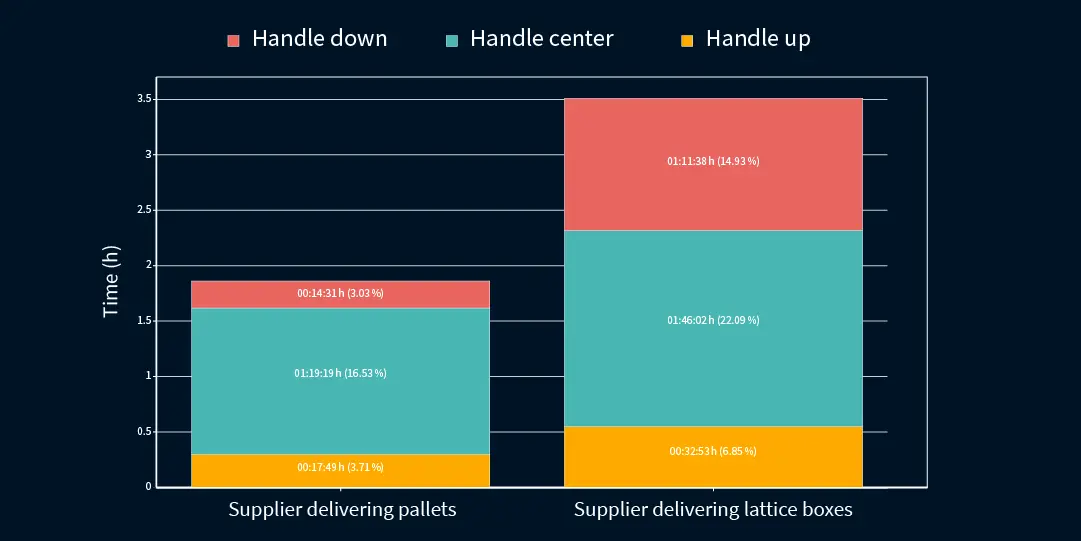
The analysis shows a clear pattern: lattice boxes increase ergonomically demanding time by 20.6%.
The stressful postures include in particular:
bent handling and
Overhead activities
On an eight-hour shift, this is equivalent to:
1 hour and 12 minutes of additional workload per employee
Extrapolated over weeks and several employees, there is a relevant risk factor for:
muscular complaints
illness-related absences
declining performance
What was previously considered “burdensome but common” can now be measurably quantified and thus addressed in a targeted manner.
Process analysis: 30% longer picking times due to lattice boxes
The process indicators also speak a clear language:
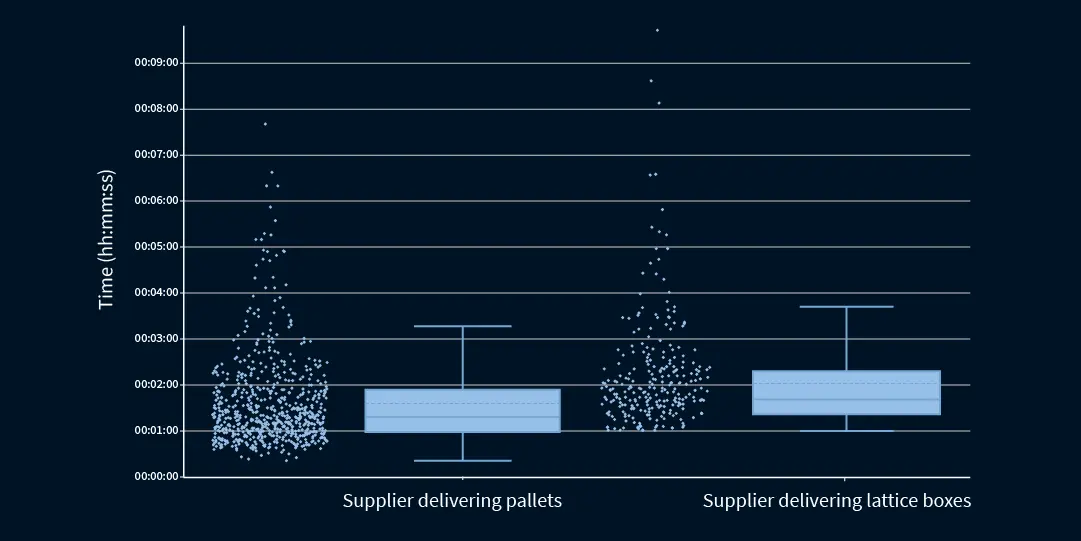
23 more seconds per pick
30% longer picking time
What initially seems like a small deviation can become a significant cost factor when picking volumes are high. For the manufacturing company, this means that lattice boxes slow down productivity. And that every day with every pick.
What companies can do now
1. Conduct supplier negotiations based on data
If a load carrier demonstrably causes higher costs, it can:
a standardized container is required,
agreed on an optimization, or
a compensation of costs will be negotiated.
2. Repackaging upon receipt of goods
If the supplier is unable to make the switch:
Repackaging into ergonomically optimized load carriers
Quick payback possible due to shorter picking times and less workload
3. Redefine charge carrier strategy
Well-founded container logic reduces variance and process fluctuations. Technical solutions can help with this, such as:
optimized special load carriers, e.g. from the provider ligenium on the MotionMiners SOLUTIONS platform
Conclusion: Data-based container design instead of gut feeling
The analysis shows that the load carrier is a process lever and not a detail.
By integrating WMS data and Motion‑Mining®, relationships that were previously only suspected can be precisely quantified. The result is a new level of process transparency: from hypothesis to well-founded insight, from black box to data-based decision.
Companies can now:
well-founded negotiation,
invest in a targeted manner,
reduce ergonomic risks,
and measurably increase the efficiency of their picking.
Motion-Mining® Technology Sheet
All information about the hardware and software at a glance.
Our free factsheet provides you with a comprehensive overview of our hardware and software solution.
Overview of the functions of the MPI Dashboard
Details about anonymization and data security
Technical specifications of the hardware and software




.webp)
%20(1).webp)