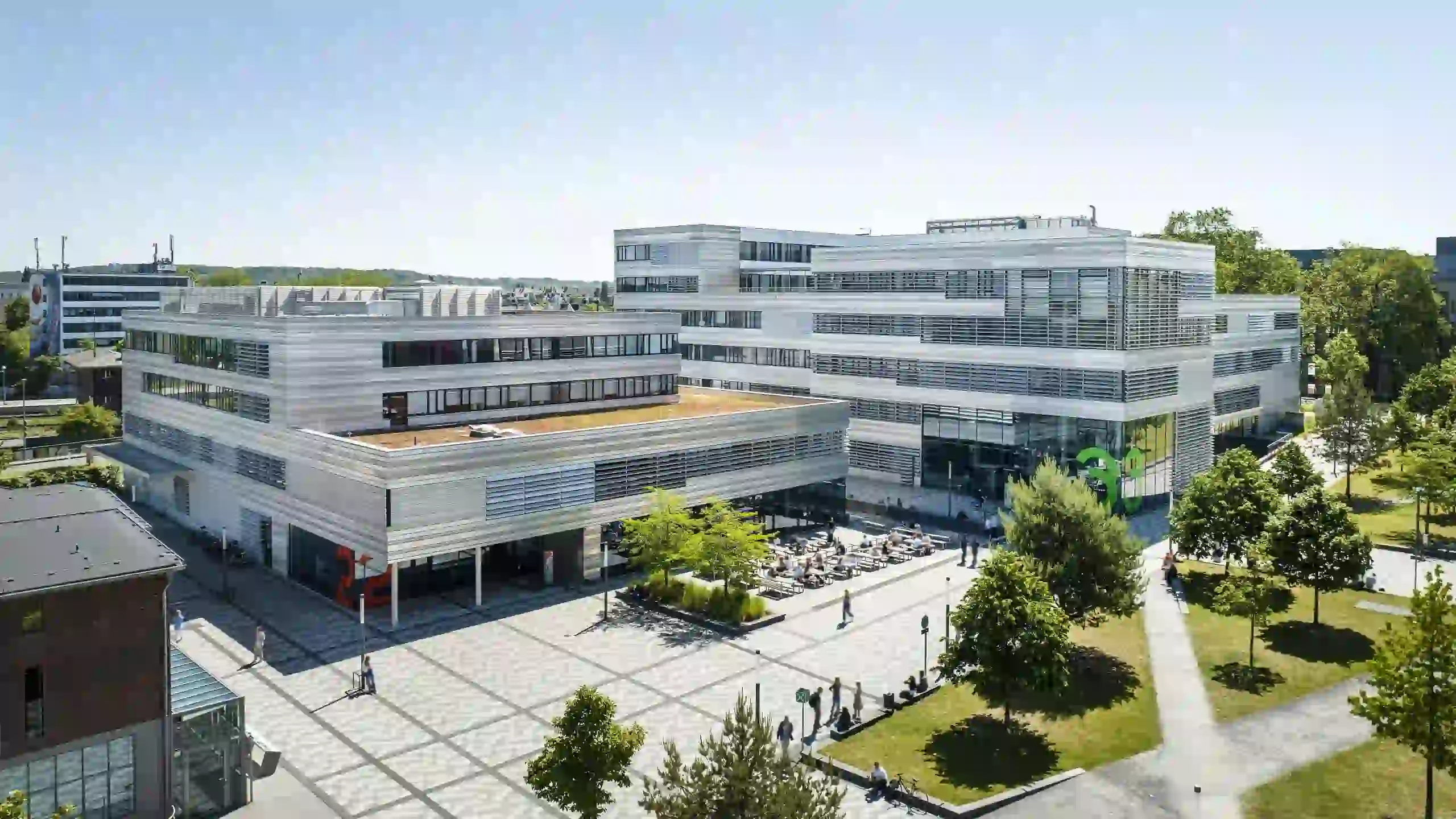
Prof. Dr. Stefan Geraedts | Department of Business Studies | Düsseldorf University of Applied Sciences
He is just as familiar with the noise of a production hall as he is with the lecture theatre. Prof. Dr. Stefan Geraedts spent 18 years in the automotive supply industry, with 16 of those years in logistics, most recently as a plant manager. Since April 2023, he has been passing on this expertise at Düsseldorf University of Applied Sciences using a tool he has already proven in practice: Motion-Mining®.
11,000 plus students | 18 years of industry experience | First contact with Motion Mining in 2019 | Integrated into teaching in 2025
The Challenge with Slides
Explaining process analysis on slides works up to a certain point. Beyond that, even the best textbook reaches its limits.
“Traditional observation methods quickly reach their limits in the classroom,” says Geraedts. What is missing is hands on experience, the moment when abstract KPIs turn into real processes that can be observed, measured and improved. This is exactly where Motion-Mining® comes in. The technology captures motion data over time, makes workflows visible and creates a data foundation for informed optimization decisions. For Geraedts, the choice was obvious: he had already implemented the system in 2019 at a former employer in the automotive supply industry to analyze internal logistics processes. What he successfully applied in practice, he has now fully integrated into his teaching.
From Case Study to Shop Floor
Today, Motion-Mining® is firmly embedded in two courses: Operational Excellence and Analytics in Industry 4.0. The structure follows a clear learning journey: students first learn the methodology and then apply it themselves, either in simulated classroom settings or in real projects with industry partners.
One project stands out in particular: at the Düsseldorf plant of automotive manufacturer Mercedes Benz, master’s students analyzed forklift traffic in a logistics hall. They captured the current state, developed data driven recommendations and ultimately presented their findings directly to plant management. No simulation. No theoretical exercise. Real responsibility, real data, real impact.
“Motion-Mining® allows my students to understand what process optimization truly means, not on slides but through real data.”
Prof. Dr. Stefan Geraedts, Düsseldorf University of Applied Sciences
Three Key Learning Moments
Geraedts recalls several defining moments from his courses, situations that reveal insights no textbook can deliver:
- The current process everyone believes they know often exists in three different versions.
- Almost every process contains optimization potential but it only becomes visible through data.
- Process optimization is ultimately about people and their involvement is not optional but essential.
Building the Right Skill Set
What do students take away from these projects? According to Geraedts, there is a clear shift from observation to data driven reasoning. Students who learn how to measure processes and justify improvements based on data develop a different mindset: more structured, more precise and more persuasive. In addition, they acquire essential skills that are difficult to teach in a purely academic setting: teamwork, self organization, customer orientation and effective communication for different target audiences. “With these competencies, students are very well prepared for the job market,” Geraedts explains. Currently, one student is independently analyzing order picking processes in the outbound warehouse of an international trading company as part of a master’s thesis using Motion-Mining®.
His advice to other universities
Tip No. 1: Start small.
There are use cases with a strong practical focus that do not require hardware, as access to the Motion-Mining® platform is sufficient.
Tip No. 2: Don't wait for the perfect concept.
It is better to start with a pilot course, especially in areas such as Lean Management, Operational Excellence or Production and Logistics, where the methodology fits naturally. Students quickly become familiar with the technology and achieve initial results in a short time. What Geraedts has observed in one and a half years of teaching is clear: the technology works, students adapt to it quickly and the moments when they first truly understand what lies behind a process stay with them long after the semester ends.
Düsseldorf University of Applied Sciences is one of the largest universities of applied sciences in North Rhine-Westphalia and maintains close partnerships with business, industry, culture, and the social sector. Prof. Dr. Stefan Geraedts has been teaching there since April 2023, specializing in Lean Management and Operational Excellence.




.webp)
%20(1).webp)


