In warehouses around the world, the majority of work is still done manually. Employees pick, transport and pack the goods, leaving hardly any digital traces behind. While automated conveyor technology is documented down to the minute, many things remain obscure when it comes to manual tasks.
- How much time do employees actually spend searching?
- Which routes result from sub-optimal layouts?
- Where do bending movements put the greatest strain on the musculoskeletal system?
- When do waiting times occur and why?
Why traditional analysis methods are no longer sufficient
Classic analysis methods such as REFA or MTM time studies as well as employee surveys only provide selective insights. They are time-consuming, difficult to scale and heavily influenced by the experience of individuals. The risk of subjective distortions is correspondingly high. There is also the Hawthorne effect: Under observation, employees change their behavior, causing the data to lose additional significance. Decisive details such as detours, waiting times or ergonomic loads often remain invisible.
The result: Inefficiencies remain hidden, potential is untapped and companies optimize based on incomplete information. Measures quickly become a guessing game.
Motion-Mining® creates a new quality: transparency
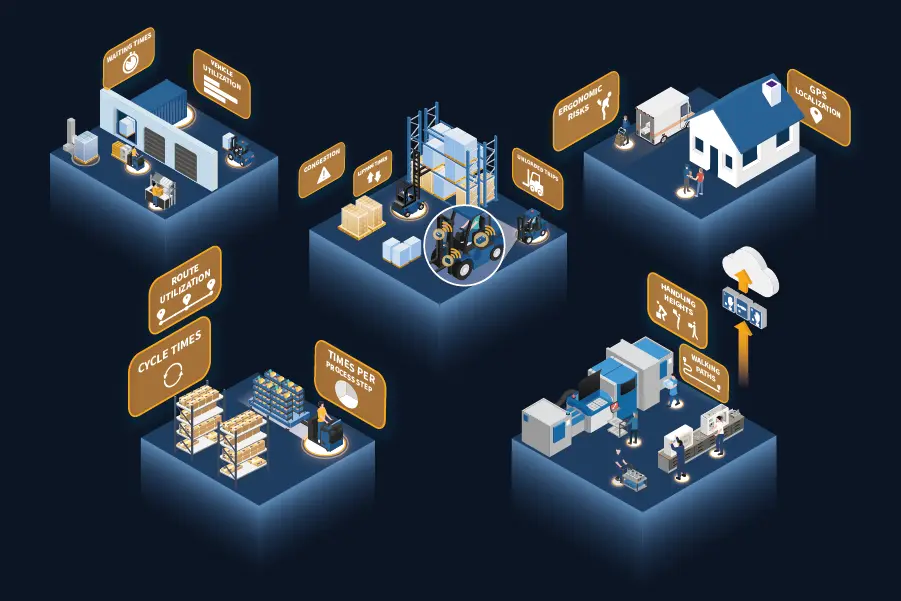
This is where Motion-Mining® technology comes in. It combines modern hardware for data collection with AI-supported software for analysis, with all data being completely anonymized and processed in accordance with GDPR. The interplay of wearables, Bluetooth beacons and intelligent algorithms creates a detailed digital image of manual processes without generating data at employee level. What you get is real process data.
hardware: Objective data collection in a real work environment
For a period of two to three weeks, employees wear wearables on their wrists and belts. These sensors collect data on movements, activities and postures, which are used for later analysis. Industrial trucks can also be equipped with vehicle loggers to document utilization, empty and full journeys, and fork positions. Bluetooth beacons in the hall and GPS in the outdoor area make it possible to locate the measured activities and movements.
softwares: From raw data to real process intelligence
The recorded data automatically flows into MotionMiners PROCESS INTELLIGENCE (MPI) software. MachineLearning algorithms then use movement patterns to identify basic activities such as walking, driving or bent postures and assign them to the respective process steps. Interactive dashboards, heat maps, route analyses and ergonomics assessments visualize the results and make bottlenecks, waiting times, ergonomic risks or long distances immediately visible. The result is a digital process map with over 100 process indicators that transparently shows optimization potential.
More depth through context data
On request, the Motion-Mining® data can also be combined with existing business systems such as WMS, ERP or MES linked become. This makes it possible to link movement and process data with order information, material flows or machine processes. In this way, it is possible to gain even deeper insights and make well-founded optimization decisions.
It is this wide range of fields of application that gives the technology added value across industries. Motion-Mining® is now used in a wide range of areas, including production logistics, in Trade and distribution centers, with logistics service providers as well as in the automotive industry. There, material supply, manual assembly or storage processes are carried out under high efficiency and ergonomic pressure. The above approach makes it possible to determine comparable, objective key figures across locations, including in pharmaceutical logistics or in industrial transport networks.
In addition to industrial practice, Motion‑Mining® also in research and teaching increasingly used. Universities and research institutions use this technology to illustrate real challenges in the areas of logistics and production to students using specific use cases and to demonstrate the use of AI methods in an operational context.
Five aspects that make Motion‑Mining® a smart choice:
- Objectivity: data instead of subjective observation
- Collection time: Temporary over 2—3 weeks instead of random samples
- Scalability: Any number of employees instead of limited groups
- Plug & Play: No IT integration required
- Data protection: Fully anonymized, GDPR-compliant
In addition to increasing efficiency through Motion-Mining® analysis, it is also possible to reduce the ergonomic load on employees, improve process quality and make strategic decisions based on reliable data.
Practical example: Pharmaceutical logistics saves 230,000€ per year
A logistics company for pharmaceutical products was faced with the challenge of evaluating and improving the efficiency of its manual processes. The complexity lay not only in the processes themselves, but also in the lack of data basis for well-founded decisions.
The comprehensive Motion-Mining® analysis of picking and packaging uncovered hidden capacity reserves and identified potential savings of around 230,000€ per year. The aim of the project was to make technology interaction and additional expenses transparent, to test single-shift operation for profitability and to create indicators across locations.
A total of eight areas of optimization were identified, including personnel planning as the biggest lever with a potential of up to 25,000 working hours per year.
→ Download the full case study with all details here
Conclusion: Manual processes require better data
Intralogistics is faced with the challenge of reconciling increasing requirements with shrinking resources. Fewer available specialists mean more jobs, while quality and cost expectations are constantly increasing. In this environment, companies can no longer afford to rely on their gut feeling and random samples.
Motion-Mining® turns assumptions into certainty. The technology opens the black box of manual warehouse processes and provides the database that modern logistics management requires.
- Objective facts replace subjective assessments
- Continuous recording provides representative results instead of selective snapshots
- Specific recommendations for action replace vague ideas for optimization
Logistics managers thus not only have transparency about their processes, but also the basis for strategic decisions — from investment planning to ergonomic workplace design to personnel planning.
Anyone who invests in data-based process analyses today secures long-term competitive advantages. Because logistics is a business driven by people — their know-how, their ability to react and their daily decisions. Their potential develops most when processes make work easier rather than make it more difficult.




.webp)
%20(1).webp)