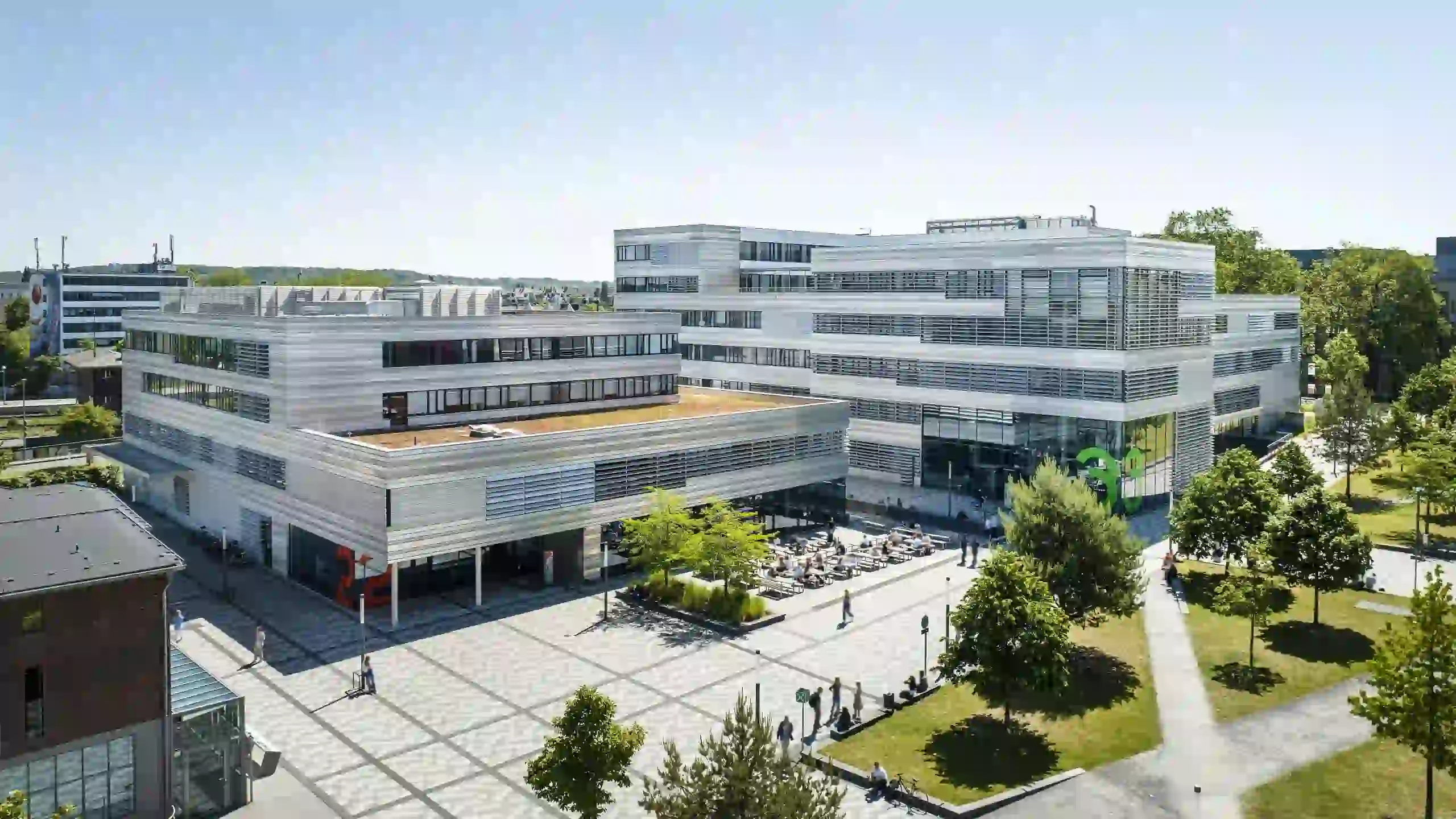
Graz is widely known for engineering excellence and technical innovation. At the Institute of Logistics Engineering at TU Graz, this tradition is now being expanded by a new dimension: data‑driven motion analysis as an integral part of academic education. Motion‑Mining® has been in use for less than a semester, yet the vision behind it extends far beyond the initial rollout.
TU Graz, Austria | Start 2026: Mobile Robotics Live | LABS-Partner
Where did the impulse come from?
The head of the institute, Professor Domenik Kaever, originally comes from Germany and has been familiar with the logistics hub of Dortmund for many years. Given that MotionMiners GmbH originated there and the Fraunhofer IML is located nearby, the first contact with the technology was a natural step.
What Professor Kaever brought with him to Graz was not only knowledge of the methodology, but also a strong conviction that Motion‑Mining® addresses a key shortcoming in academic teaching: the lack of real practical relevance in traditional lecture‑based formats.
“We want to promote practical application and interactive learning,” says Kaever. Those who collect data themselves, analyze it and derive improvements gain a deeper, more sustainable and applicable understanding of processes.
Where the institute stands today
At present, Motion‑Mining® is used in teaching as a concrete illustration tool focused on one specific topic: human‑centered workplace design. Ergonomics is an ideal entry point because the questions are tangible and easy to relate to. How does a person move within a work process? Where do physical strains occur? Where is there potential for improvement?
With motion data, these questions can suddenly be answered based on evidence rather than theory alone. This is exactly where the institute uses MotionMiners LABS.
However, it is not only students at TU Graz who benefit. The technology is also presented to the institute’s network of industry partners. The background is a challenge frequently observed in practice: data on the movement behavior of humans and machines is often not available at the level of quality required for sound consulting and decision‑making. Motion‑Mining® closes this gap.
The roadmap: what comes next
What makes the Institute of Logistics Engineering particularly interesting is not only its current use of Motion‑Mining®, but also the direction in which it is developing. Three concrete initiatives are already defined:
- Currently active
Use of Motion‑Mining® as a teaching aid, with a focus on ergonomics and human‑centered workplace design.
- In planning
Use case “Order Picking Data Analysis”: material flow analysis with a focus on human movement, based on data collected by students themselves. This use case will be integrated into the courses Material Flow Engineering and Material Flow Planning and System Design.
- Summer semester 2026
First implementation in the course Mobile Robotics. In the new “Mobile Robot Collaboration Space” of the laboratory, Motion‑Mining® will be used to analyze the movements of mobile robots in a targeted way.
“With Motion‑Mining®, we are educating the data scientists of tomorrow — not only for logistics, but far beyond,”
Professor, Institute of Logistics Engineering, TU Graz
Humans and machines: a new learning field
Particularly exciting is the connection that is emerging at TU Graz: using Motion‑Mining® not only for human motion analysis, but also for mobile robots. In a logistics environment where humans and machines increasingly work side by side, understanding both movement patterns becomes a key competence. The new laboratory provides the physical foundation for this development.
This approach reflects the institute’s broader ambition: teaching logistics not merely as a planning discipline, but as a living system that can be measured, understood and actively designed.
Recommendation from practice: Based on experience, the most effective way to introduce Motion‑Mining® is through courses with a strong practical focus. Students should learn to apply the technology themselves: collecting data, analyzing it and deriving improvement measures.
Ergonomics‑related applications are particularly well suited, as they are immediately tangible and make the connection between data points and human experience directly visible.
The Institute of Logistics Engineering at Graz University of Technology conducts research and teaching at the intersection of material flow engineering, system design and digital technologies. As a LABS partner of Motion‑Mining®, it combines fundamental research with applied industrial consulting.


.webp)
%20(1).webp)